
The Anatomy of a Powerful FP&A Tool
In today’s business environment, finance teams can no longer survive on spreadsheets and siloed systems. CEOs expect agility, boards demand forward-looking insights, and business leaders want finance to be more of a partner than a scorekeeper.
Enter the modern FP&A tool—a platform designed not just to automate planning and reporting, but to fundamentally change how finance adds value. But what makes an FP&A tool truly powerful?
Let’s break down its anatomy.
1. A Single Source of Truth
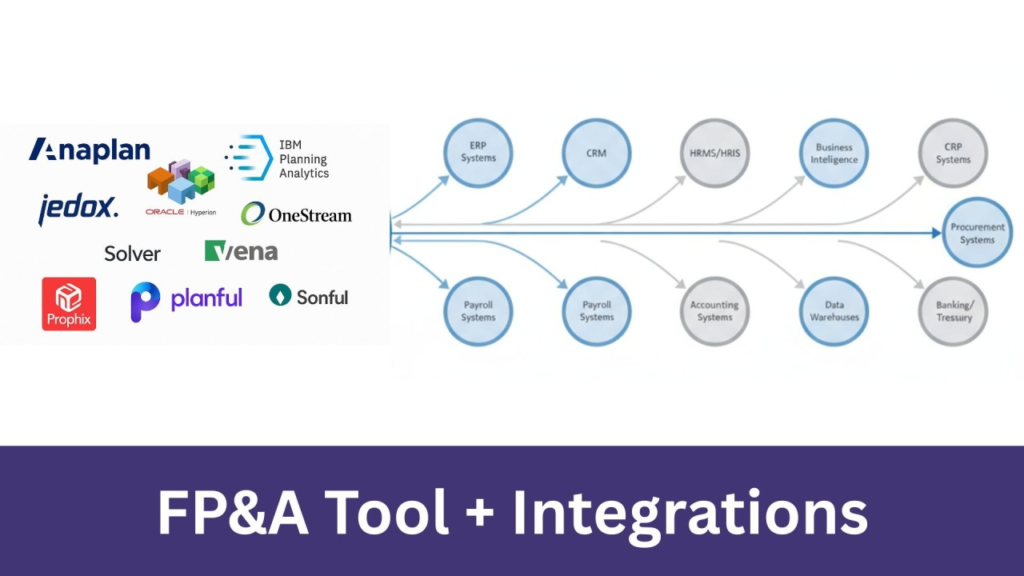
At the heart of every powerful FP&A tool lies data integration. Finance cannot drive meaningful insights if numbers are scattered across ERPs, CRMs, HR systems, and spreadsheets.
A strong FP&A platform must:
- Pull data seamlessly from multiple systems
- Maintain data consistency with clear definitions
- Enable drill-downs from consolidated reports back to transactional detail
Example: Instead of debating whether sales and finance are using the same revenue figures, both teams view data from the same unified dashboard. This eliminates “spreadsheet wars” and frees time for analysis.
2. Driver-Based Modeling Capabilities
The real strength of FP&A isn’t reporting history—it’s predicting the future. A powerful FP&A tool allows for driver-based planning: linking financial outcomes to operational levers.
- Revenue models tied to customer acquisition, churn, and pricing
- Cost models tied to headcount, utilization, and raw material consumption
- Cashflow forecasts tied to payment cycles and seasonality
This makes scenarios dynamic. Instead of adjusting hundreds of line items, finance can test: “What happens if churn rises by 2%?”—and instantly see the ripple effects across P&L, balance sheet, and cashflow.
3. Scenario Planning and Agility
In a volatile world, a plan is outdated the moment it’s published. Powerful FP&A tools must allow for fast scenario planning:
- Best case, base case, worst case simulations
- Multi-variable stress tests (inflation, FX changes, demand shocks)
- Rolling forecasts updated in real-time
Example: During a supply chain crisis, a manufacturer can test scenarios: “If shipping costs double, how do we protect gross margin?” Leadership then makes data-backed decisions in days, not weeks.
4. Collaboration at the Core
FP&A doesn’t work in isolation. Budgets and forecasts touch every corner of the business. A powerful FP&A tool must be built for collaboration, not just consolidation.
- Departmental inputs gathered in structured workflows
- Real-time commentary embedded alongside numbers
- Alerts and notifications when assumptions are changed
This ensures business units don’t feel “finance is imposing numbers,” but that planning is a shared exercise where assumptions are visible and co-owned.
5. Advanced Analytics and Visualization
Powerful FP&A tools don’t stop at tables—they bring numbers to life. Dashboards and analytics help leadership digest complexity at a glance.
- Heat maps showing performance hotspots
- Waterfall charts bridging actuals to forecast
- Trend lines revealing hidden seasonality
- AI-powered anomaly detection
Instead of 50-slide decks, finance leaders deliver story-driven insights that provoke decisions, not yawns.
6. Scalability and Flexibility
Every organization evolves. A tool that works for a $100M company may break at $500M. A powerful FP&A tool must grow with the business:
- Scalable to handle more users, geographies, and data volumes
- Flexible enough to model new business lines, M&A integrations, or reorganizations
- Configurable without requiring heavy IT support each time
This ensures finance remains a strategic enabler, not a bottleneck.
7. Cloud, Security, and Accessibility
Modern finance teams work globally, across time zones. A powerful FP&A tool must be cloud-native:
- Accessible anytime, anywhere
- Secure with role-based access and audit trails
- Regularly updated with no downtime for patches
This flexibility is no longer optional—it’s expected.
8. Embedded Intelligence
The next frontier of FP&A tools is AI and machine learning. These features don’t replace finance—they amplify it:
- Predictive forecasting using historical data patterns
- Automated variance explanations (“Marketing overspent due to X campaign”)
- Intelligent recommendations on resource allocation
Finance teams move from reactive reporting to proactive advising, backed by machine-augmented intelligence.
Case in Point: The CFO’s View
Consider Aura Tech, a SaaS company scaling from $50M to $200M ARR. Before adopting a powerful FP&A tool, their finance team:
- Spent 3 weeks consolidating budgets
- Produced static forecasts, updated quarterly
- Delivered reports that were outdated by the time they hit the board
After implementation:
- Forecasts are refreshed monthly using rolling driver-based models
- Scenario planning allows instant “what-if” analysis on churn or pricing
- Department heads submit inputs directly in the system, building trust in the process
- Finance is now in the boardroom not as a note-taker, but as a decision architect
The Anatomy Summarized
A truly powerful FP&A tool combines:
- Integration: A single source of truth
- Modeling: Driver-based forecasting
- Agility: Fast scenario planning
- Collaboration: Shared ownership of numbers
- Analytics: Clear, decision-ready storytelling
- Scalability: Growth without breaking
- Cloud & Security: Always accessible, always safe
- Intelligence: AI-enabled foresight
Final Thought
The anatomy of a powerful FP&A tool is not just about software—it’s about transforming finance into the strategic nerve center of the business. The right tool doesn’t replace FP&A—it empowers it, ensuring finance leaders can move from reporting the past to shaping the future.
Looking for an FP&A Tool? Get on a call with us and we can help you select the best one that fits your requirements.